

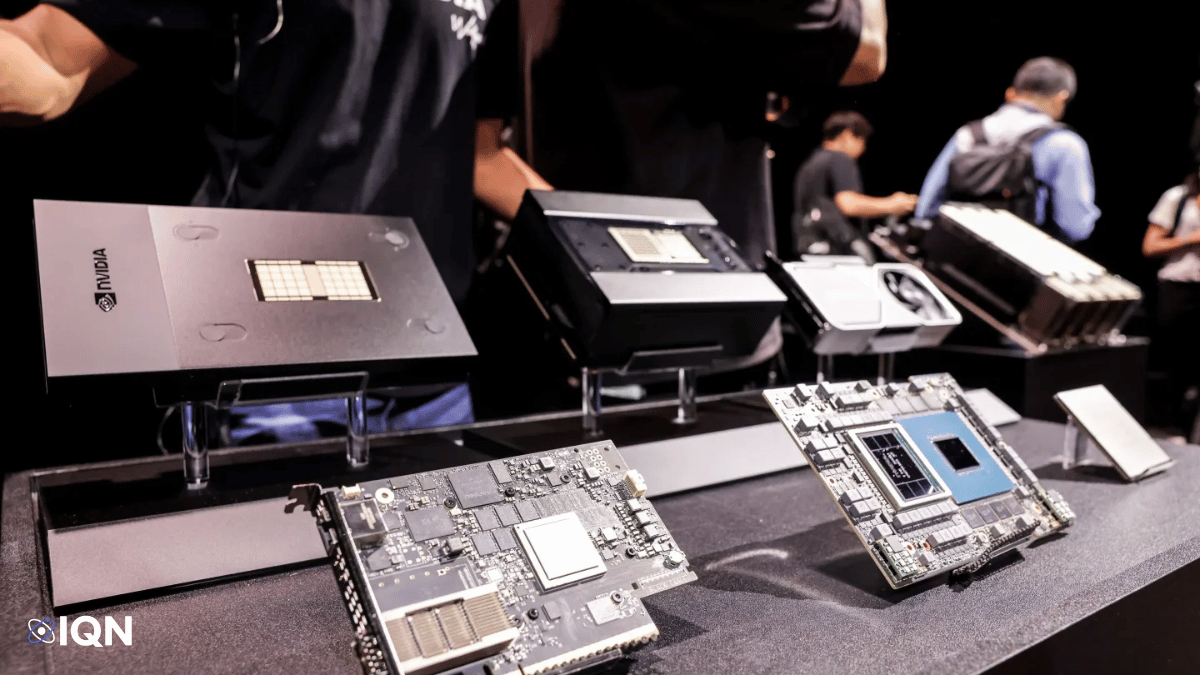
IQN (NewsDesk): IonQ has announced it will place the first on-site quantum computer inside NVIDIA’s Accelerated Quantum Research Center (NVAQC), a facility built specifically to tackle the engineering challenges of merging quantum processors with large-scale GPU infrastructure. The deployment, planned for 2027, pairs IonQ’s newest trapped-ion system directly with NVIDIA’s most advanced AI hardware.
Wiring a QPU Straight Into an AI Supercomputer
Under the agreement, IonQ will install its sixth-generation Superion 256 quantum processing unit at NVAQC and connect it directly to an NVIDIA GB200 NVL72 rack using NVIDIA’s NVQLink interconnect. Hybrid workloads spanning both the quantum and classical sides of the system will be coordinated through NVIDIA’s open-source CUDA-Q platform.
The joint research effort will focus on co-designing tightly integrated quantum-GPU architectures and building open hybrid software frameworks, with the explicit goal of producing open results and a shared guide for future AI and quantum-GPU co-design work. Target applications include portfolio optimization and financial risk modeling, materials science research relevant to data centers, and computational chemistry for drug discovery.
“Deploying our Superion 256 into cutting-edge environments, such as NVIDIA’s NVAQC, will lead to developments allowing our partners to benefit from our scalable architecture and robust manufacturability,” said IonQ Chairman and CEO Niccolo de Masi, adding that the partnership marks the start of an extended era of hybrid quantum-classical computing spanning multiple future generations of hardware.
NVIDIA’s vice president and general manager for quantum, Timothy Costa, put the ambition even more broadly, saying every supercomputer will eventually become a quantum supercomputer, and describing the Superion 256 as a step toward integrating QPUs with AI infrastructure using open models and open-source software.
Built to Skip the Custom Cryogenics
The Superion architecture, unveiled earlier in September 2026, was specifically engineered to avoid the bulky, free-space optical laser systems that older trapped-ion machines depend on. Instead, it uses chip-scale Electronic Qubit Control, technology that traces back to IonQ’s acquisitions of Oxford Ionics and SkyWater Technology. By relying on planar semiconductor manufacturing, IonQ says the platform is designed to scale from its current 256 qubits toward more than 10,000, with cryo-CMOS logic built in so that full systems can fit inside standard data center server racks rather than requiring custom cryogenic or optical buildouts.
The NVAQC announcement follows closely on the heels of joint research published by IonQ, NVIDIA, Oak Ridge National Laboratory, and the University of Tennessee at IEEE Quantum Week 2026, which combined generative AI with distributed quantum algorithms running on CUDA-Q to tackle combinatorial optimization problems.
Timed for Maximum Attention
The announcement landed on the opening day of Quantum World Congress 2026 in College Park, Maryland, just hours after IonQ separately unveiled what it called the industry’s first end-to-end real-time quantum error-correction decoder capable of running on a single off-the-shelf CPU. That decoder was validated across simulated circuits involving up to 408 logical qubits and more than 31.5 million individual quantum operations, adding negligible delay to overall computation time. The pair of announcements, one behind the other within roughly 14 hours, helped drive a sharp rally in IonQ shares (covered separately below).